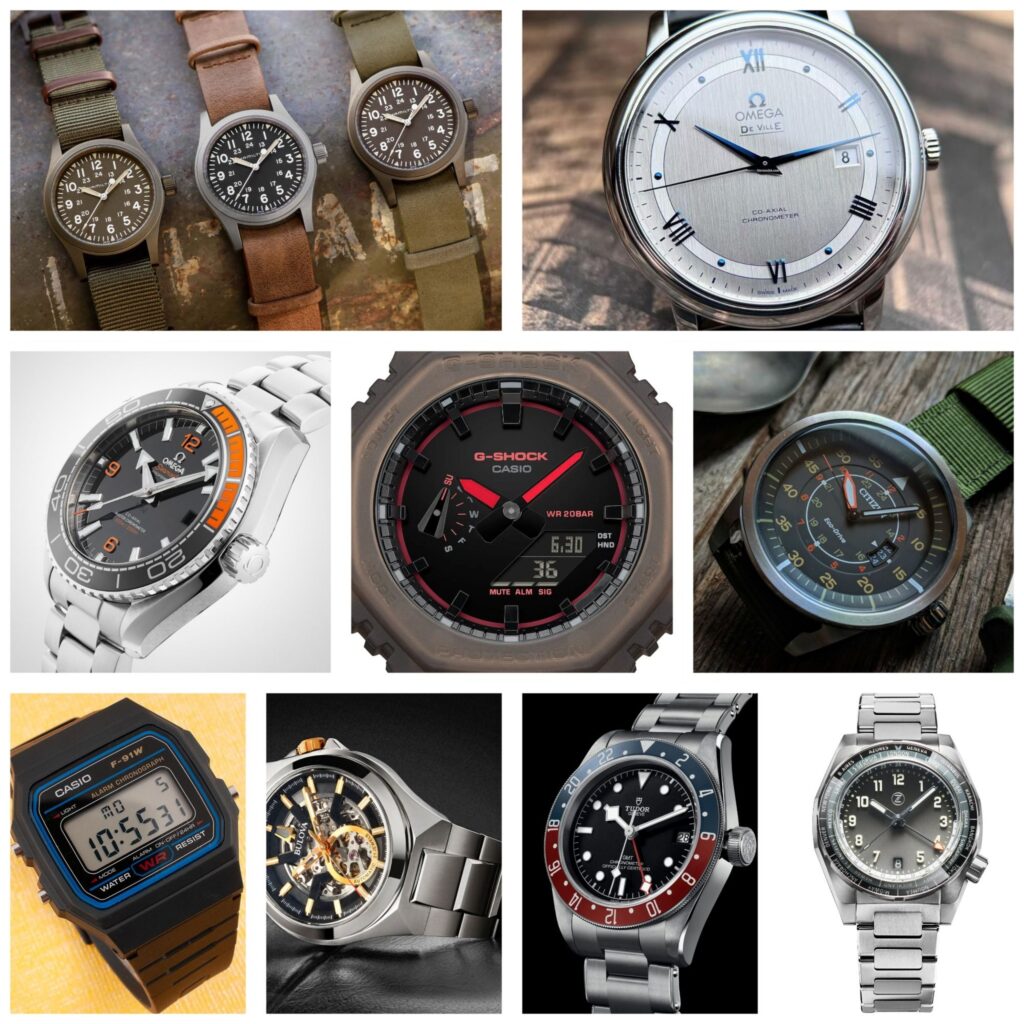
Watch Movements Explained: Automatic, Quartz, Digital & Everything In Between
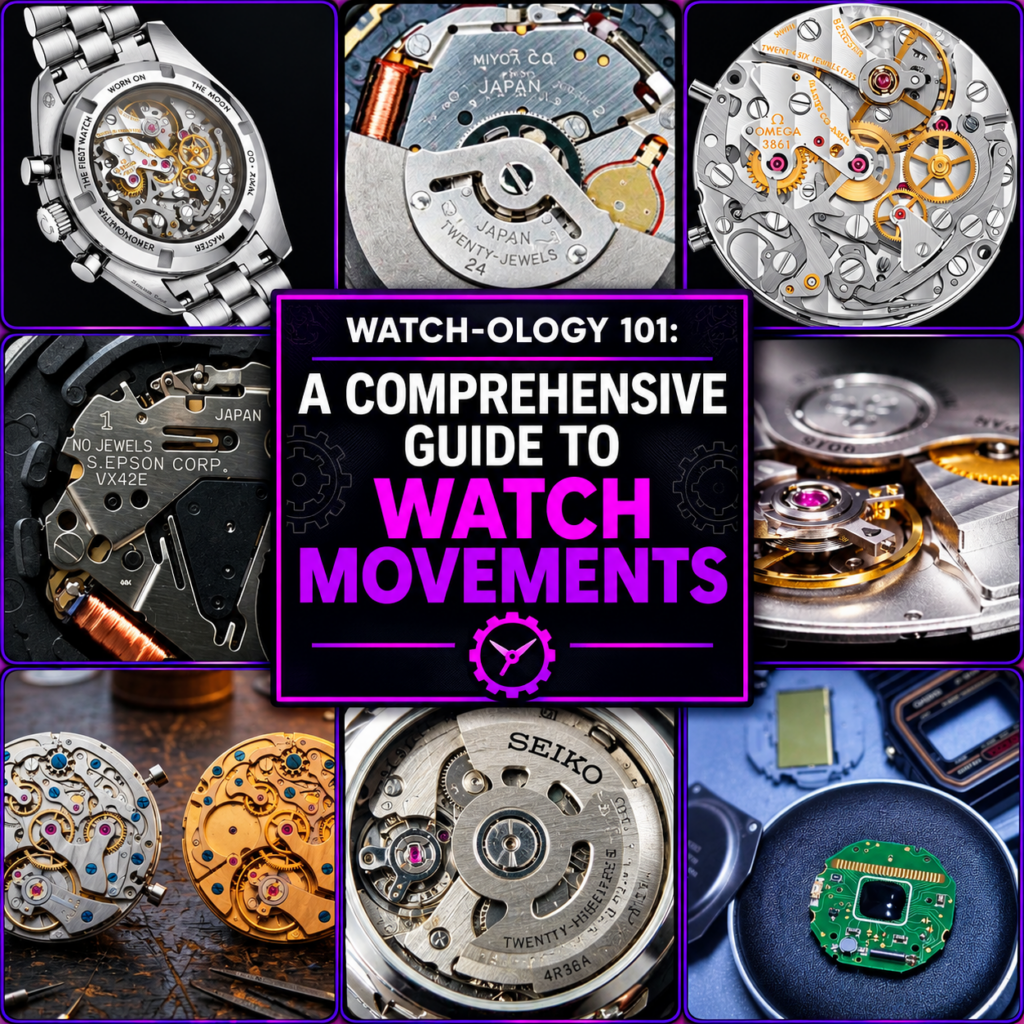
Quick links
Automatic
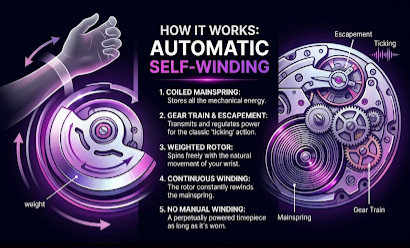
How it works
A coiled mainspring stores energy and releases it through a gear train and escapement — the classic “ticking” mechanical action. What makes it automatic is a weighted rotor inside the case that spins freely with the natural motion of your wrist, continuously winding the mainspring so you never need to wind it by hand.
Why people love them
- No daily winding required, as long as you wear it regularly
- Full mechanical charm, often visible through a display caseback
- The most popular movement type among collectors
Thicker than manual movements (to fit the rotor), and it will stop if left unworn for a day or two, needing to be reset.
Origins
Invented by British watchmaker John Harwood, who patented a self-winding mechanism in 1923 and brought it to market commercially with Swiss manufacturer Fortis in 1926 — the first mass-produced automatic wristwatch.
- Watches known for it
- Seiko 5, Omega Seamaster, Rolex Submariner, Tudor Black Bay, most microbrand dive watches.
- Recognizable calibers
- Seiko NH35/NH36 (sold in-house as the 4R35/4R36), Miyota 8215 and 9015, ETA 2824-2, Sellita SW200 — these are the “workhorse” movements you’ll see referenced constantly in reviews and forums, since they power the vast majority of affordable automatics.
- Typical price range
- £150+ at the affordable end (Seiko 5, microbrands), rising to £4,000+ for Swiss luxury automatics.
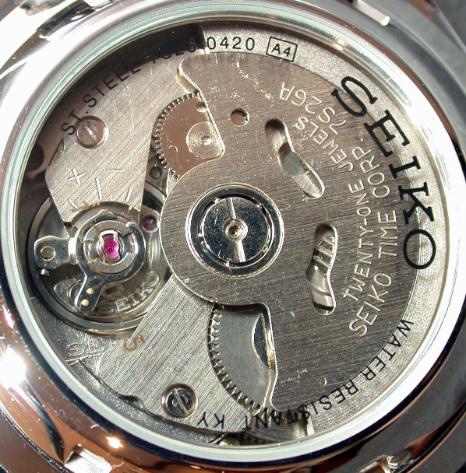
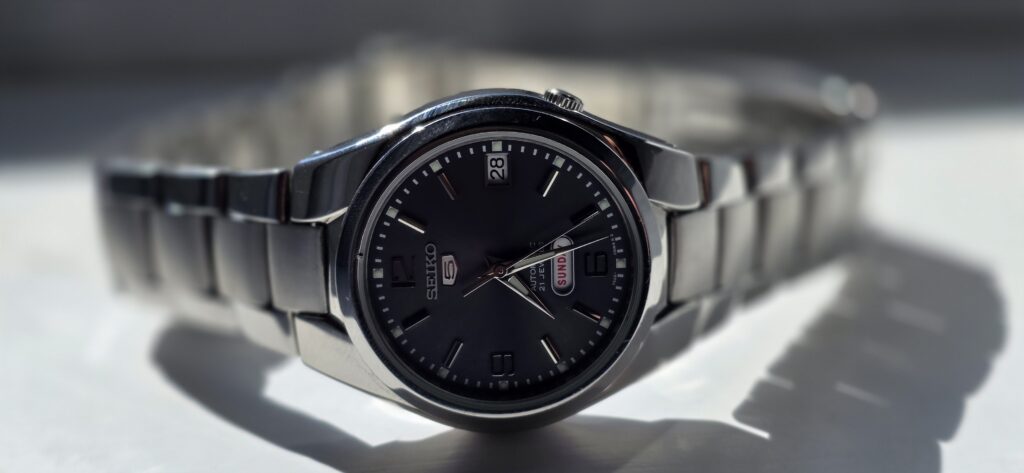
An automatic movement is really just a hand-wound movement with a rotor bolted on — remove the rotor, and you’re left with the same core mechanism watchmakers have been refining for 500 years.
Mechanical
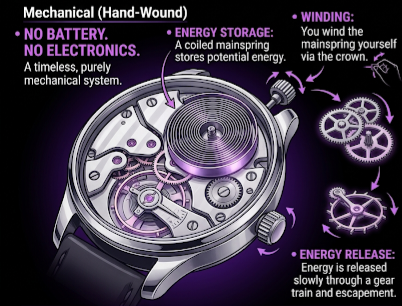
How it works
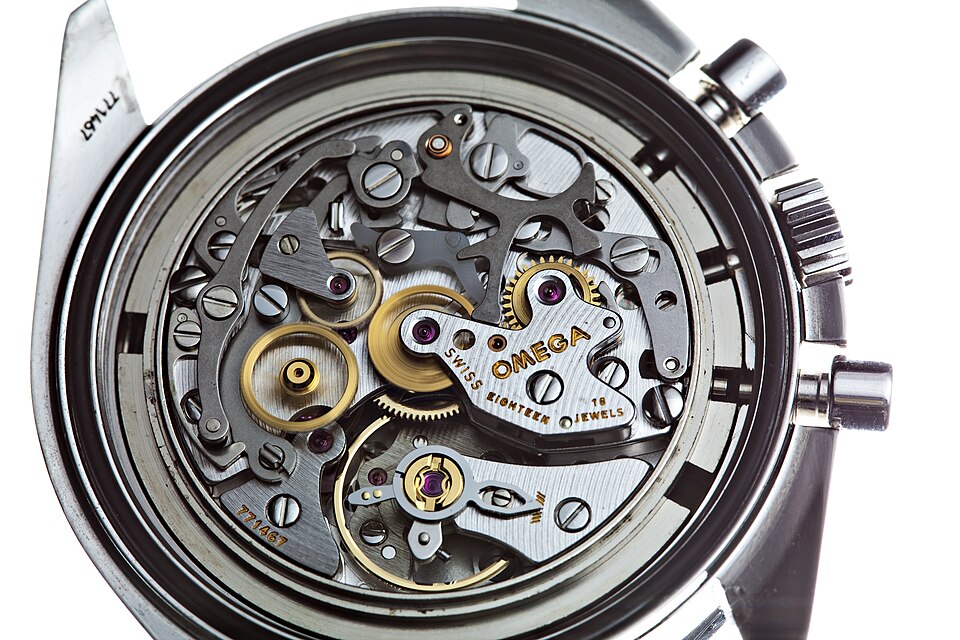
Mechanically identical to an automatic, minus the rotor. No battery, no electronics — you wind the mainspring yourself via the crown, and it slowly releases that energy through the gear train.
Why people love them
- Pure mechanical craftsmanship, often visible through the caseback
- Winding it becomes part of the daily ritual of owning it
- Tends to allow thinner cases than automatics, since there’s no rotor to fit
You have to remember to wind it (usually daily), and accuracy is measured in seconds per day, not per month.
Origins
The oldest movement type on this list by centuries — spring-driven mechanical timekeeping dates back to portable clocks and early pocket watches in the 1500s, long before the wristwatch existed. Every other mechanical movement type on this list, including automatic, is fundamentally built on this same foundation.
- Watches known for it
- Rolex Cellini, Patek Philippe Calatrava, many Hamilton and Longines dress watches, entry-level manual pieces from Seiko and Orient.
- Recognizable calibers
- ETA/Unitas 6497 and 6498 (large, easy-to-see pocket-watch-derived movements popular in field watches), Seagull ST36 (a low-cost Chinese-made alternative found in many budget manual watches).
- Typical price range
- £80–200 for entry-level manual pieces, climbing well into the thousands for Swiss dress watches.
Harwood’s original watches had no crown at all — you set the time by rotating the bezel. Rolex’s later Oyster Perpetual (1931) became so closely tied to automatic watches in the public mind that Rolex eventually had to publicly acknowledge Harwood as the true inventor.
Digital
How it works
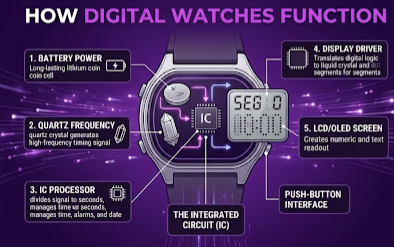
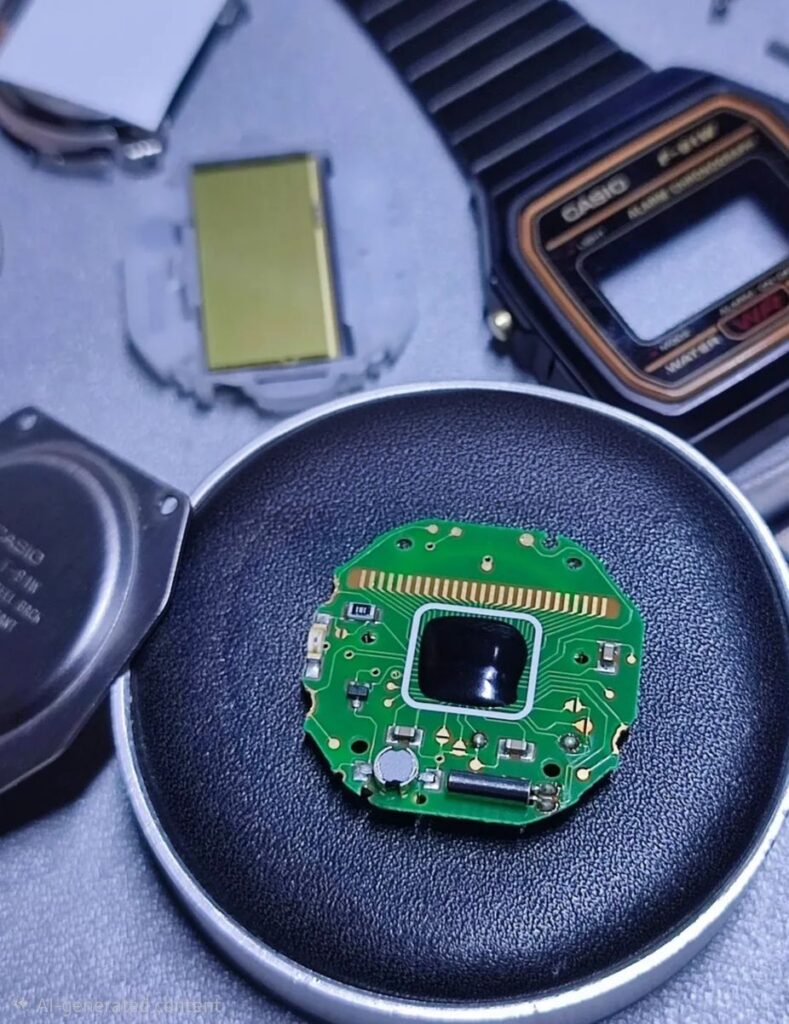
No hands at all — a quartz oscillator drives an electronic circuit that displays the time directly as numbers on an LCD screen. Mechanically it’s a cousin of analog quartz, but the output is digital rather than a geared hand display.
Why people love them
- Extremely accurate and low maintenance, same as analog quartz
- Extra functions are easy to add: stopwatch, alarms, backlight, world time
- Very durable and shock-resistant, since there are far fewer moving parts
Lacks the traditional “watch” aesthetic many collectors want; battery life varies a lot depending on backlight/feature use.
Origins
The first electronic digital watch was the Pulsar P1, released in 1972 by the Hamilton Watch Company. It paired a quartz chip with a red LED display and cost around $2,100 at launch — roughly $12,000 in today’s money.
- Watches known for it
- Casio F-91W, Casio G-Shock (digital and combi models), Timex Ironman.
- Recognizable calibers
- Digital watches don’t really use “calibers” in the traditional sense — Casio instead labels its digital electronics as numbered “modules” (printed on the caseback), which enthusiasts reference the same way collectors reference calibers on mechanical watches.
- Typical price range
- £15–150 for the vast majority of digital watches.
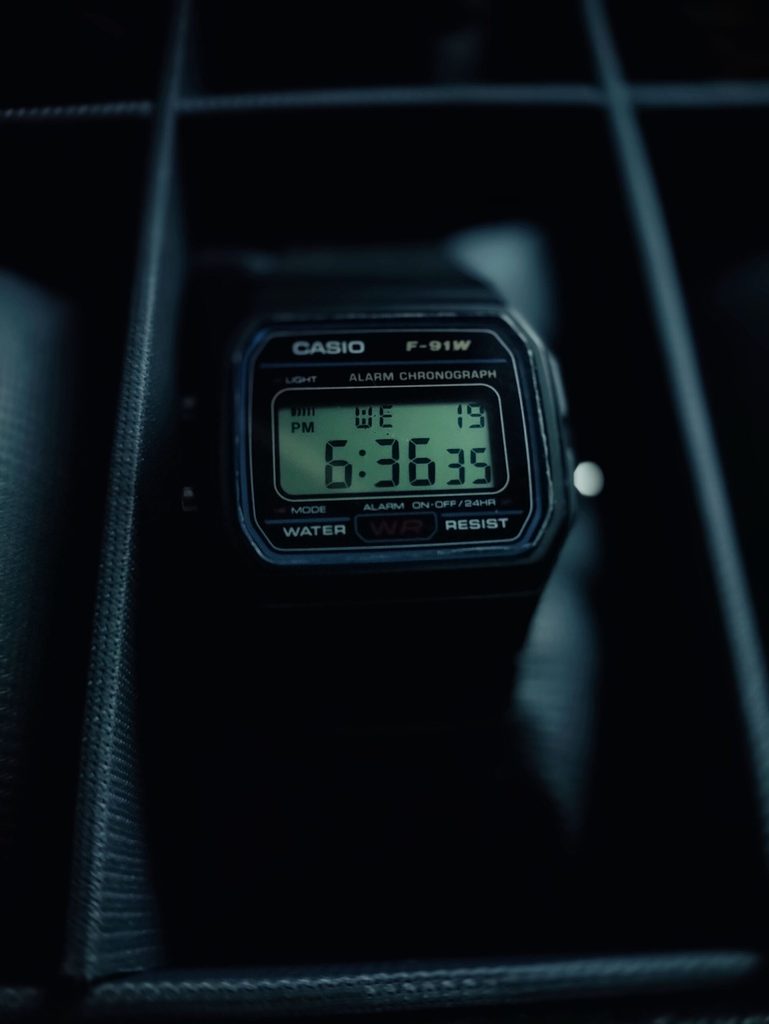
The Pulsar P1’s LED display used so much power that it couldn’t stay lit continuously — wearers had to press a button just to see the time. It also made a memorable cameo on Roger Moore’s wrist in the 1973 James Bond film Live and Let Die.
Quartz
How it works
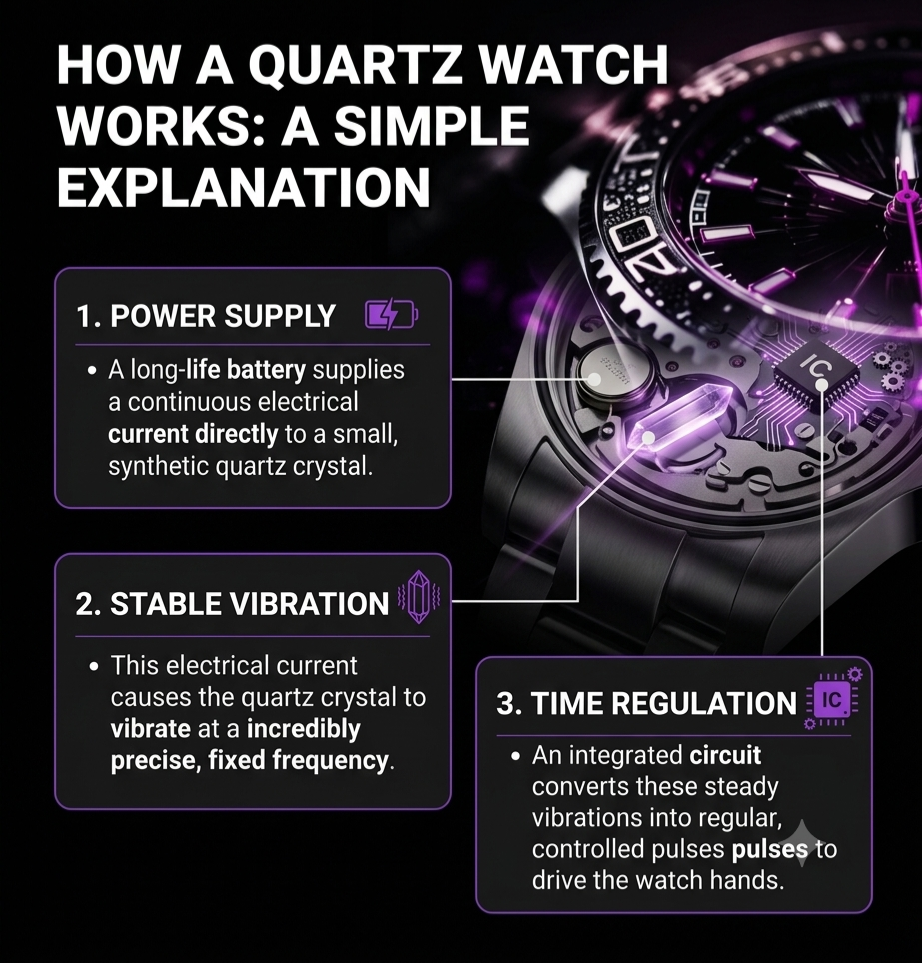
A battery sends current through a tiny quartz crystal, which vibrates at a precise, fixed frequency. A circuit converts those vibrations into a steady pulse that drives the hands forward, second by second.
Why people love them
- Extremely accurate (within seconds a month)
- Low maintenance — just a battery swap every 1–3 years
- Affordable to produce, which keeps prices low
Seen by some collectors as less “romantic,” since it’s electronics rather than visible mechanical craftsmanship.
Origins
Introduced by Seiko on Christmas Day, 1969, with the Astron 35SQ — the world’s first quartz wristwatch. It triggered what the industry still calls the “Quartz Crisis,” when cheap, ultra-accurate quartz watches nearly wiped out traditional Swiss mechanical watchmaking over the following decade.
- Watches known for it
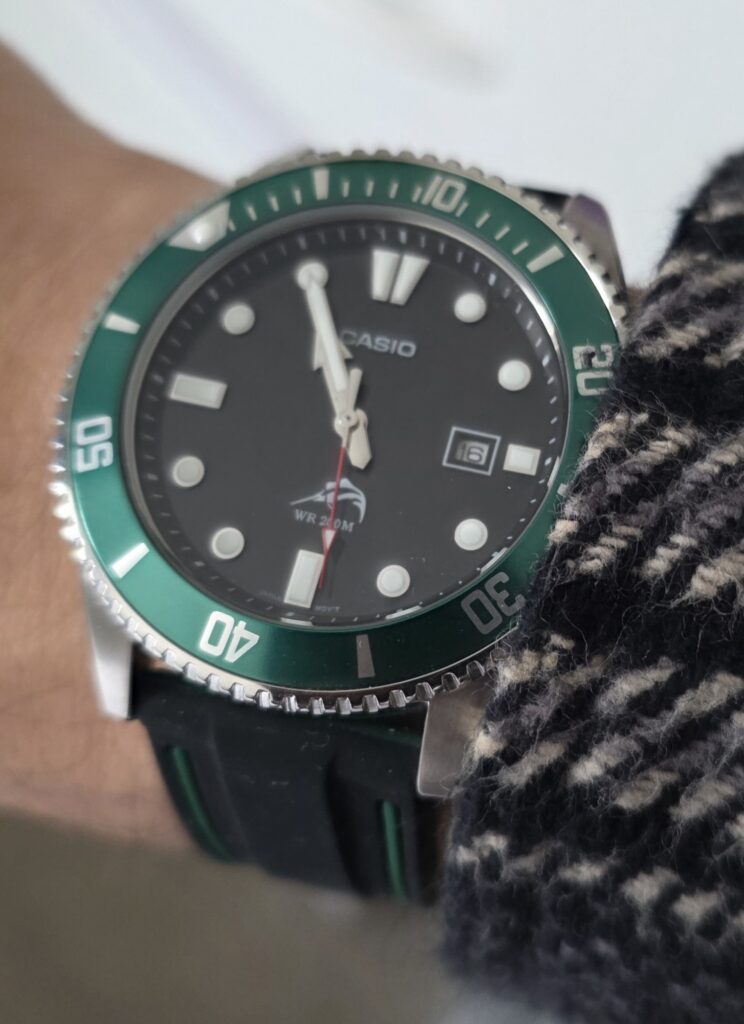
- Casio G-Shock, most Timex and Citizen everyday watches, Seiko 5 (quartz models), Grand Seiko’s premium 9F caliber.
- Recognizable calibers
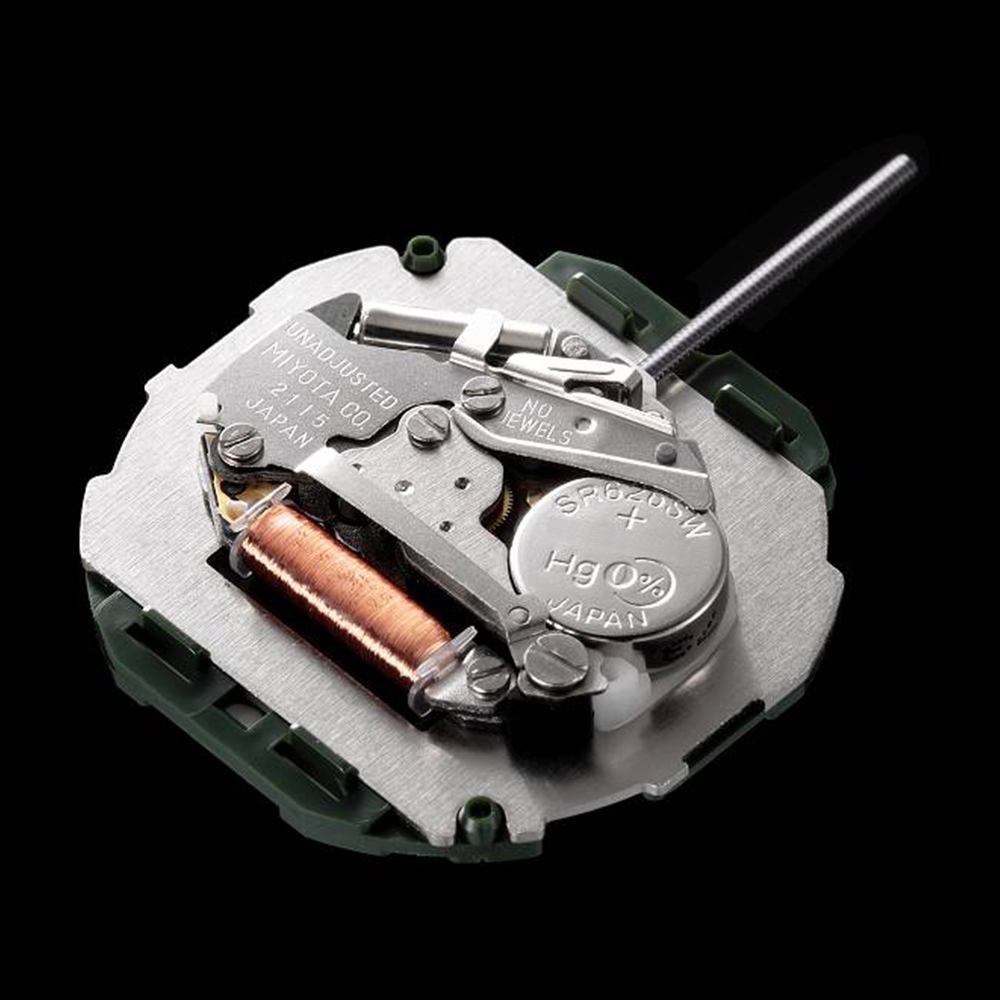
- Miyota 2115 (a common, inexpensive workhorse found across countless budget and microbrand watches), Seiko’s VX and VH series calibers — these rarely get marketed by name, but they’re worth knowing if you ever need a replacement part.
- Typical price range
- £20–100 for most everyday quartz watches, £2,000+ for Grand Seiko’s high-accuracy 9F caliber.
The original Seiko Astron cost around the same as a mid-size car at launch — roughly the price of a Toyota Corolla in 1969 Japan.
Solar Quartz
How it works
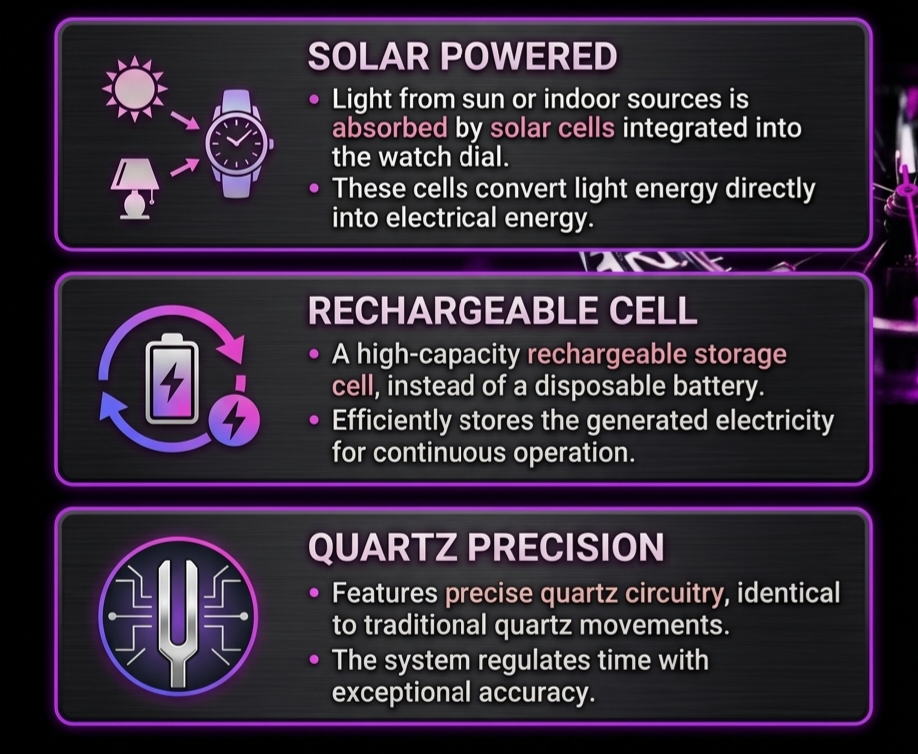
Identical quartz circuitry underneath, but instead of a replaceable battery, a solar cell built into the dial converts light (sunlight or indoor light) into electricity, which charges a rechargeable cell.
Why people love them
- Effectively never needs a battery replacement
- Great “grab and wear” watch — even months in a drawer usually isn’t a problem
- More environmentally friendly than disposable batteries
Needs occasional light exposure to stay charged; very dark dials can be slightly less efficient at absorbing light.
Origins
The first solar-powered watch was the Synchronar 2100, built by American engineer Roger Riehl in 1972. Citizen entered the space in 1976 with the Crystron, and refined the concept over decades into the Eco-Drive technology it’s known for today.
- Watches known for it
- Citizen Eco-Drive (the best-known example), some Seiko and G-Shock “Tough Solar” models.
- Recognizable calibers
- Citizen doesn’t market its Eco-Drive caliber numbers as heavily as Seiko or Miyota do with theirs, but the technology is broadly consistent across the entire Eco-Drive range regardless of which specific watch it’s in.
- Typical price range
- £100–300 for most Eco-Drive and Tough Solar models.
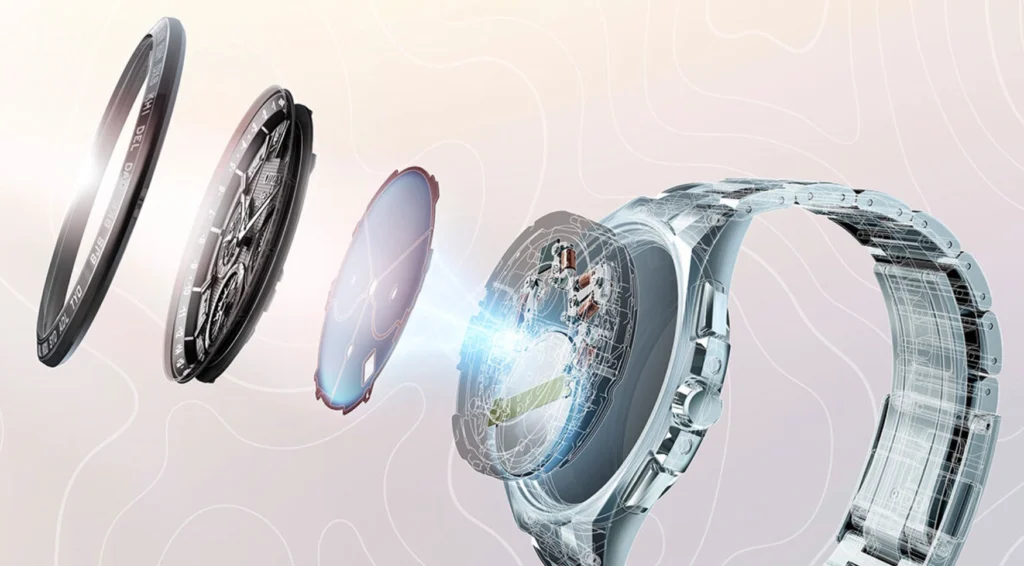
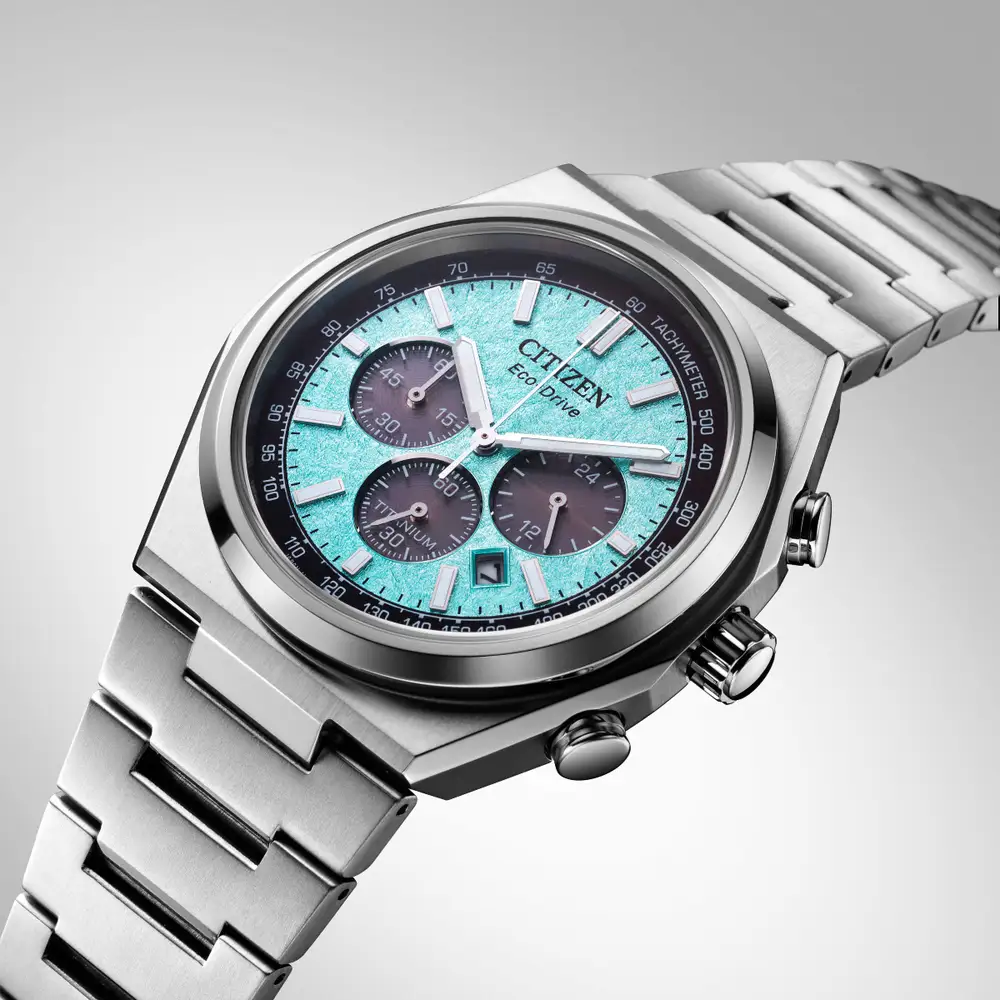
The original Synchronar had its solar panels mounted openly on top of the case, giving it a spaceship-like look decades before “smartwatch” was even a word — and it stayed in production all the way until 2007.
Mecha-Quartz
How it works
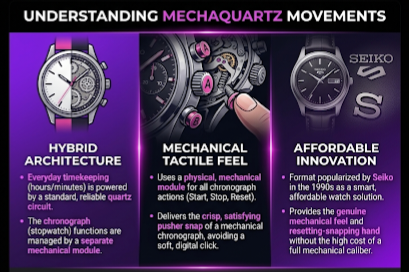
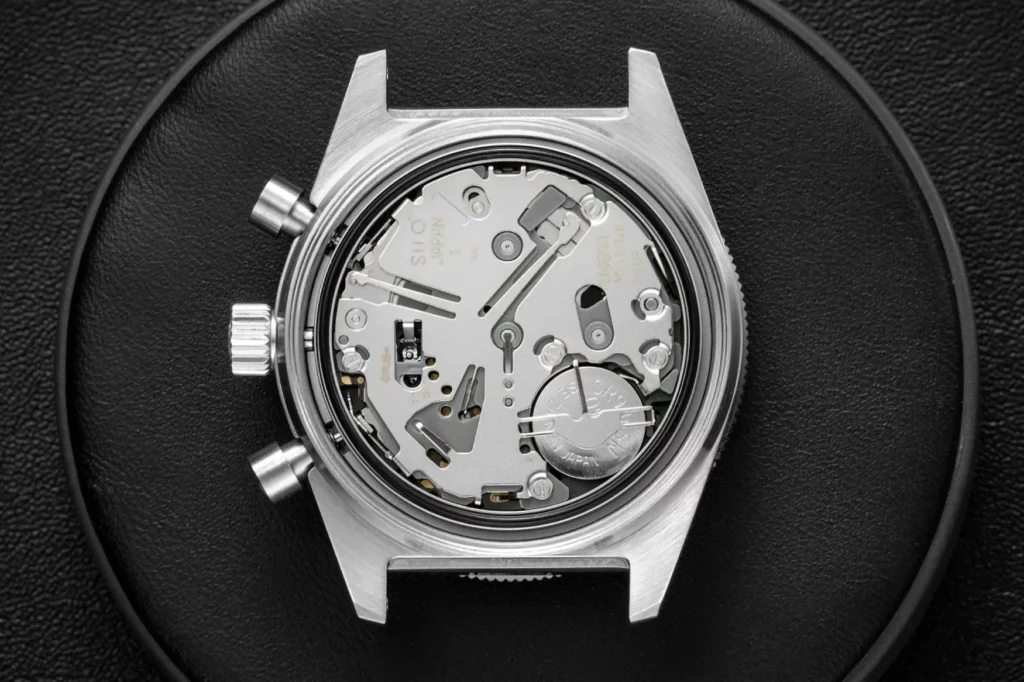
A hybrid built specifically for chronographs (stopwatch watches). The everyday timekeeping is run by a standard quartz circuit, but the chronograph function — start, stop, reset — is driven by a small mechanical module, which is why you get that satisfying, mechanical-feeling snap when you press the pushers, unlike the softer feel of a fully digital quartz chronograph. Seiko popularized the format in the 1990s as an affordable way to give quartz watches that mechanical-chronograph feel without the cost of a fully mechanical caliber.
Why people love them
- Quartz-level accuracy for everyday timekeeping
- A mechanical, tactile feel when using the chronograph pushers
- Much cheaper to produce than a fully mechanical chronograph
If the mechanical chronograph module fails, replacement parts and qualified repair are harder to find than for either a standard quartz or fully mechanical watch — it’s a niche part in a niche category.
Origins
Pioneered in the late 1980s by Swiss manufacturers like Jaeger-LeCoultre and Frédéric Piguet, mechaquartz was created to bridge quartz accuracy with mechanical tactile feel. By pairing a quartz timekeeping module with a mechanical gear train and hammer-system for the chronograph, it delivered dead-on precision alongside the sweeping hand motion and crisp reset of a traditional mechanical watch.
- Watches known for it
- Seiko’s popular meca-quartz chronographs (e.g. the “Seiko 5 Sports” chrono variants), many affordable field-chronograph microbrands.
- Recognizable calibers
- Seiko VK63 and VK64 are the two calibers you’ll see referenced constantly in meca-quartz reviews — they’re the industry-standard choice for affordable mechanical-feeling chronographs.
- Typical price range
- £150–350 for most meca-quartz chronographs.
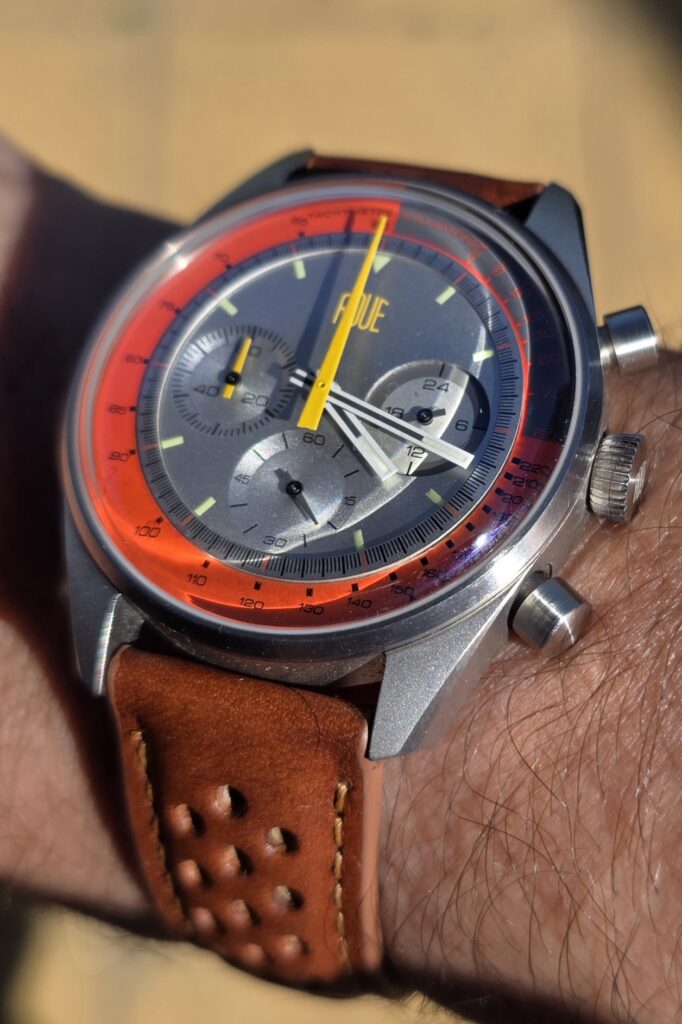
Collectors often shorten “meca-quartz” to just “mecaquartz” in conversation — if you see either spelling online, they’re referring to exactly the same hybrid technology.
Kinetic
How it works
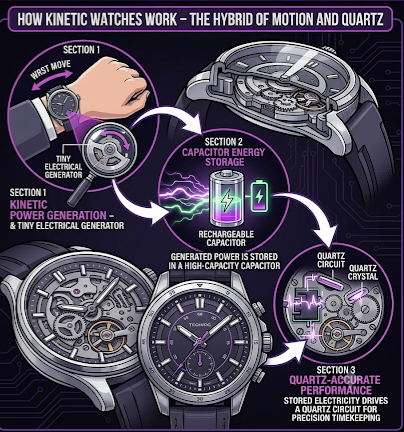
A Seiko-specific hybrid, launched in 1988 as Seiko’s answer to a specific problem: how to get quartz-level accuracy without relying on disposable batteries or sunlight. Like an automatic, a rotor spins with wrist motion — but instead of winding a mainspring, that motion drives a tiny electrical generator, storing the resulting charge in a capacitor. The watch then runs on that stored electricity through a quartz circuit, just like a rechargeable version of a standard quartz movement.
Why people love them
- Combines automatic-style “wear it and it charges” convenience with quartz-level accuracy
- No battery replacement needed, and no light required (unlike solar)
- A genuinely clever piece of engineering to point out to non-watch friends
More complex mechanically than either automatic or quartz alone, which can mean pricier servicing if something goes wrong; less common today than in its 1990s–2000s heyday.
Origins
Introduced by Seiko in 1986 at the Basel Fair under the name “AGM,” Kinetic technology bridged the gap between mechanical engineering and quartz accuracy. It transformed kinetic energy from the wearer’s wrist movements into electrical power using an oscillating rotor to charge an internal capacitor, giving quartz timekeeping perpetual power without the need for traditional battery replacements.
- Watches known for it
- Seiko Kinetic line (various dress and dive models from that era).
- Recognizable calibers
- Seiko 5M62 and 5M85 are the calibers most commonly found in Kinetic watches from the line’s heyday.
- Typical price range
- Mostly found on the used/vintage market today, roughly £50–150.
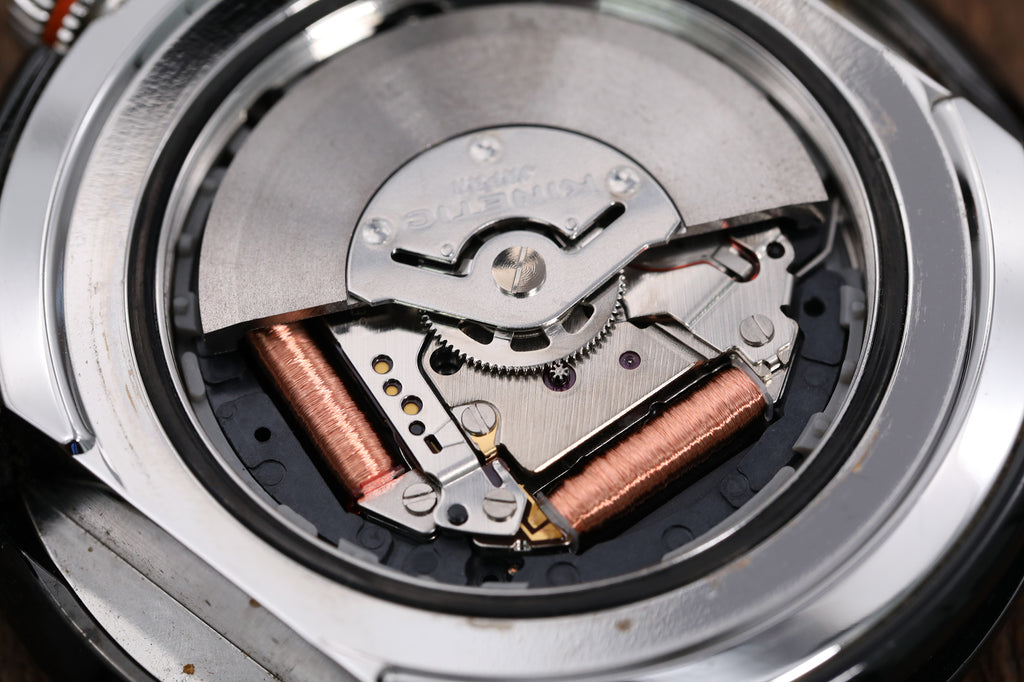
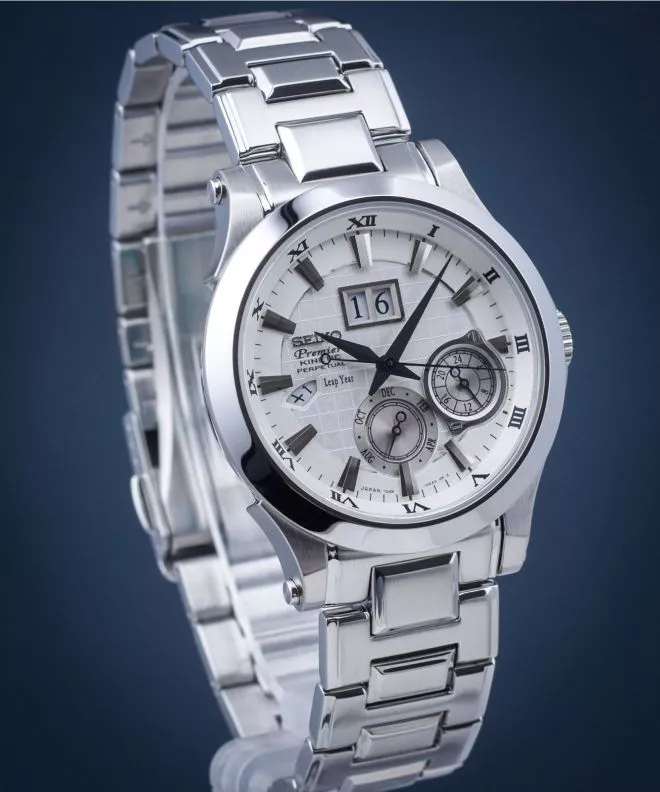
Kinetic watches were Seiko’s direct response to solar technology from rival Citizen — proof that even watch movements have their own quiet rivalries playing out behind the dial.
Radio Controlled/GPS
How it works
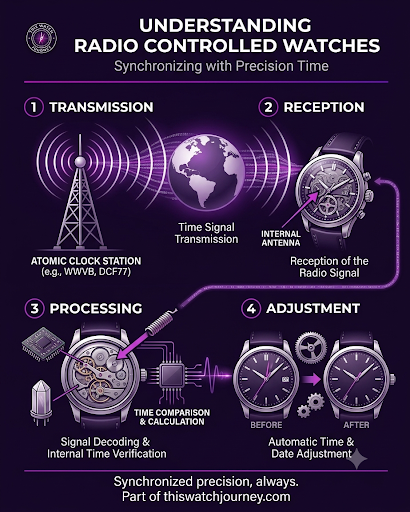
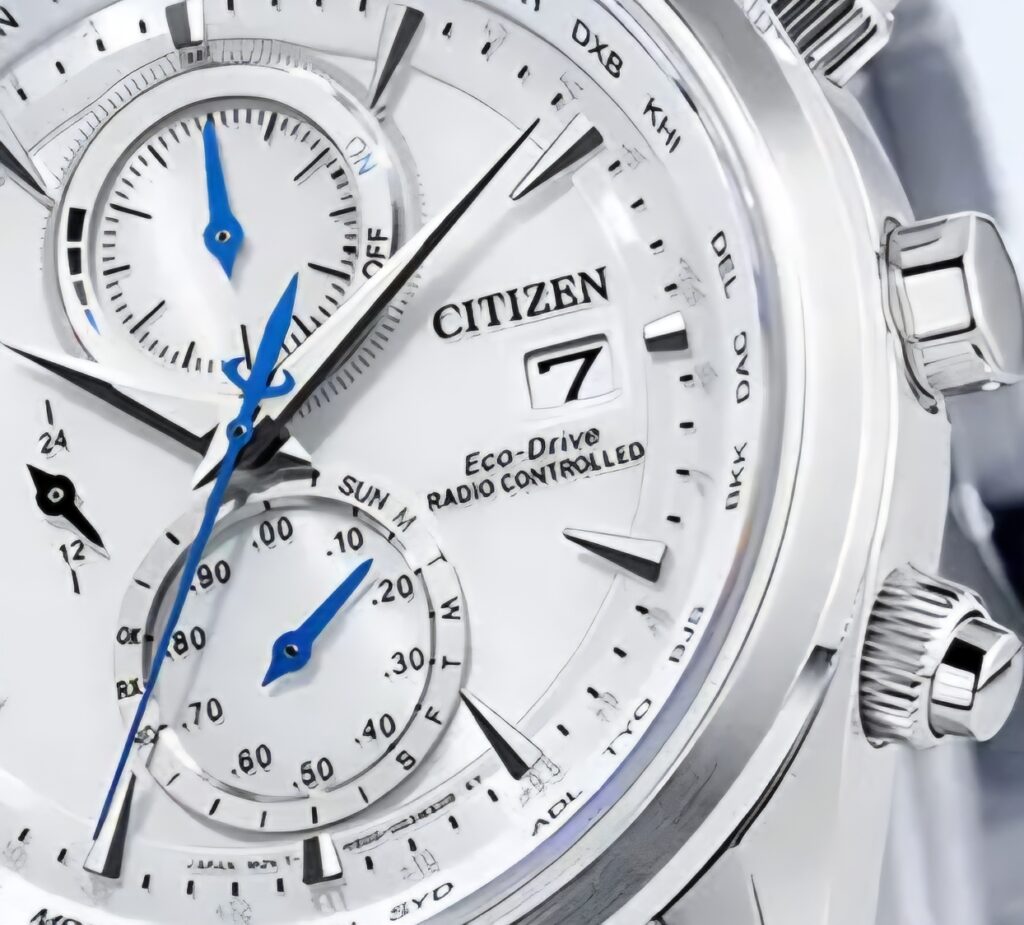
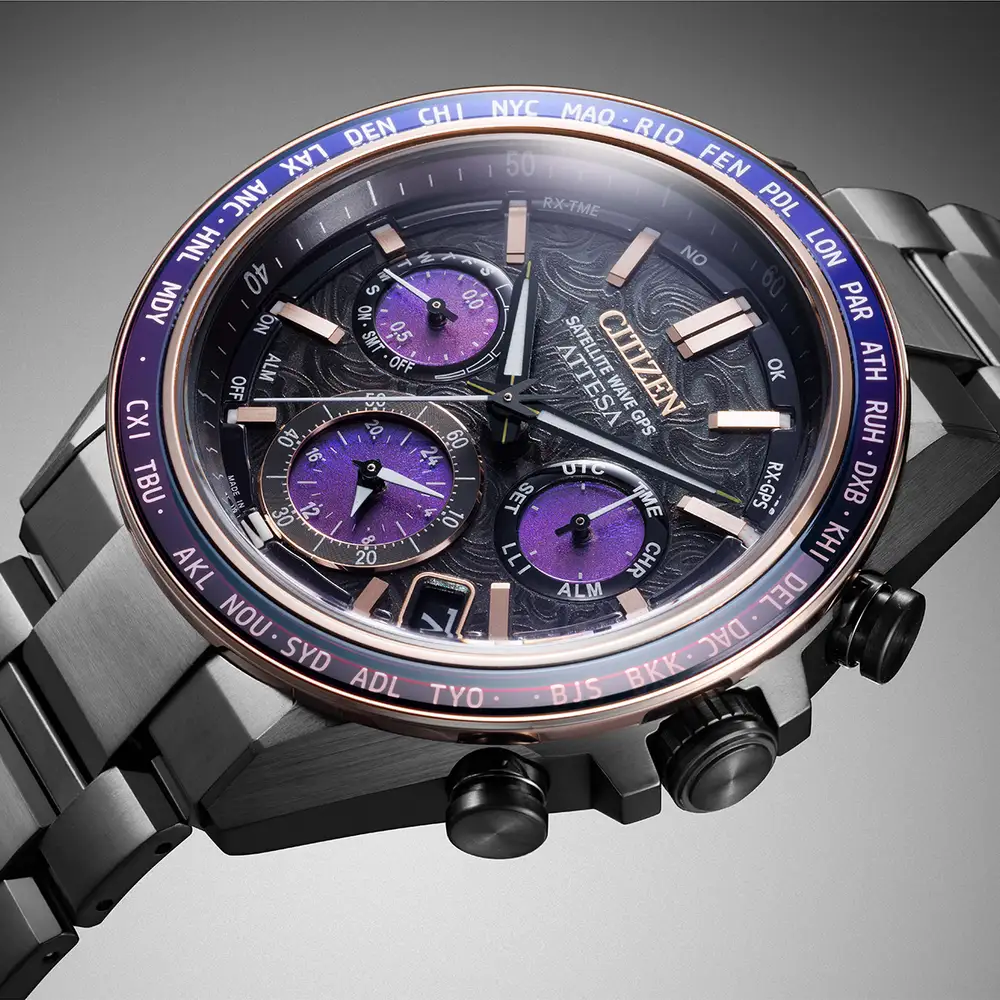
Builds on quartz accuracy by adding external time correction. Radio-controlled watches pick up a longwave radio signal broadcast by atomic clock stations (there are only a handful worldwide) to auto-correct the time. GPS watches do the same job using satellite signals instead, which works globally rather than being limited to regional radio towers.
Why people love them
- Effectively perfect accuracy, self-correcting without you doing anything
- GPS versions also auto-adjust for time zone when you travel
- Often paired with solar charging for a genuinely “set and forget” watch
More complex and expensive than standard quartz; GPS versions use more power, so battery/solar management is more involved.
Origins
German brand Junghans released the Mega 1 in 1990 — the world’s first radio-controlled watch — followed by an analog version with hands in 1991. GPS timekeeping arrived over two decades later with Seiko’s Astron in 2012, the first watch to sync to satellites rather than ground-based radio towers.
- Watches known for it
- Citizen Attesa/Eco-Drive Satellite Wave, Casio G-Shock GPS models, Seiko Astron.
- Recognizable calibers
- Citizen’s H800 powers most of its radio-controlled Eco-Drive line, while Seiko’s 5X53 and related 5X-series calibers drive its GPS Solar Astron watches.
- Typical price range
- £300–500 for radio-controlled models, £400–800+ for GPS models like Seiko Astron.
The Junghans Mega 1 hid its radio antenna inside the strap itself, since a full-size antenna couldn’t fit inside the case in 1990 — an elegant workaround for a genuinely bulky piece of 1990s technology.